Showing posts with label 1970s Cinema. Show all posts

Friday, March 11, 2022

They Don't Make Movies Like "They Shoot Horses, Don't They?" Anymore

One reason "They don't make movies like they used to" is because They Shoot Horses, Don't They? Rather, they don't make mainstream movies like the offbeat 1969 drama. Although powerful and gripping, with outstanding performances by the cast, They Shoot Horses, Don't They? would be far too nihilistic for a wide modern audience. Sure, someone could make a film this melodramatically dark, but don't expect audiences to turn the feature into a big hit like ticket buyers did more than five decades ago.


Dance Away the Inhumanity

They Shoot Horses, Don’t They? isn’t a film about horses. Instead, the feature focuses on humans being treated worse than animals. In the film’s opening, someone shoots a horse that suffers a broken leg, a sad incident, but the shooter intends to end the life of a suffering creature humanly.

The title may imply a tragic western along the lines of John Wayne’s The Shootist (1976). This Sidney Pollack film isn’t an “oater,” as Post-World War I Santa Monica’s seaside location has nothing to do with dusty Arizona or Texas towns. No one rides horses, but the many characters dance. 


The film involves a marathon dance contest where desperate partners dance for hours on end, with few breaks and great suffering, to win a $1,500 prize. The Great Depression rages, and some participants have no other options in life. So, these sad strangers come together for a shot at the winner-takes-all prize. They also subject themselves to horrible debasement.
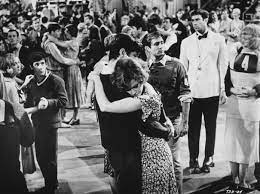


The dance contest promoters have little or no care for the troubled souls putting their health at risk. The dancers are like horses, maltreated horses. Those in charge of the rodeo ride them into the ground, caring not about their lives. 


As depressing as They Shoot Horses, Don’t They? is the film provides telling insights into human nature. Amoral people take advantage of the downtrodden, and those with few options in life must go along with the scheme. A longshot, no matter how degrading, brings some chance at financial - and potentially spiritual - renewal.


Critics adored the engrossing film, which rose to “classic new wave cinema” status. The question remains - what compelled audiences to purchase $12 million in tickets to see this dark, downbeat experiment?


They Watch Dramatic Shockers, Didn't They?

A film’s “shock factor” may involve more than excessive violence or adult content. Controversial plots might stun audiences not expecting to see what they encounter, and even a realistic melodrama could leave audiences uneasy. Since the film’s controversy comes from human drama and not exploitation, a larger audience might be willing to explore the film. The chances for such a ticket-selling outcome were likely much greater in 1969 than today. Movies were mostly G and PG-rated affairs, at least since the end of the pre-code days.

Younger persons forget that the average home had only four to six television channels, and network and local standards and practices kept things mostly at or below PG levels. Content could be controversial, but nihilism wasn’t typical network broadcast material - unless the networks chose to broadcast an edited version of a successful and controversial motion picture. Viewing an uncut version required visiting the theater. The controversy created curiosity, and audiences would pay to see downbeat films. At least they were more inclined to do so in the 1960s and 1970s.

Brutal cinematic examinations of the human condition were new in 1969. These dark novelties drew curiosity seekers looking for something far different from what they typically saw at the movies.

Talented filmmakers knew how to tap into that audience back then. Times change, and so do audience motivations and tastes. That's why you don't see films like this one anymore. Audiences moved on to escapism, having shot the horse of new wave experimental cinema long ago.


Please check out my collection of essays on Amazon Kindle - Universal Monsters and Neurotics: Children of the Night and Their Hang-Ups.


Monday, May 29, 2017

Jan-Michael Vincent Really Was On The Edge Of Greatness (Book Review)

One of the more unique and bittersweet biographies available in print and Kindle is the outstanding Jan-Michael Vincent Edge of Greatness by David Grove. Much like the brilliant look at the last few years of Groucho Marx in Raised Eyebrows, this bio paints a unique and intriguing, poignant, and somewhat sad portrait of the talented actor. Unlike Raised Eyebrows, Grove's work doesn't focus on a period of a few short years. The book covers the entire life of the great and underappreciated actor.


And Jan-Michael Vincent was simultaneously brilliant and underappreciated. Most well-known for his brilliant portrayal of the hitman apprentice appearing alongside Charles Bronson in the original The Mechanic (1972), the Disney hit The World's Greatest Athlete (1973), along with the cult television series Airwolf (1984 - 1986), Vincent appeared in a host of other memorable television programs and television movies and a few forgotten classic films of the 1970s. (How many Generation X members recall a young Jan-Michael Vincent on the "Danger Island" episodes of The Banana Splits Show )


(Jan-Michael Vincent in his iconic role in 1972'a The Mechanic)

Jan-Michael Vincent garnered a few starring roles, but he never broke through to major stardom. Grove's book -- published by Bear Manor Media -- points out that Vincent never had a major box office hit outside of his Disney vehicle and the 1977 cult hit White Line Fever. The latter film owed its success to the CB/trucker movie fad. The actor gained no major star momentum from either hit.


It may be added that bouncing between cinematic releases and guest appearances on television likely over-exposed him. Appearances on prime-time television crime shows probably undermined his chances at more prominent roles in major studio movies.


Vincent also tended to select some truly obtuse films to appear in. These movies' lack of box office success did little to keep his career on an upwards trajectory.


Grove's book is worthwhile reading for anyone who fondly remembers Jan-Michael Vincent's memorable work in the 1970s and 1980s, but be forewarned: the tale is not always the happiest one.

Sunday, February 26, 2017

A Bit of Marketing Magic Could Have Helped 1977's Sorcerer

The box office failure of 1977's Sorcerer is consistently blamed on being released around the same time as Star Wars.

True. The gritty and realistic documentary-like thriller did come out the same month as the mega sci-fi hit.

So what?


The film should have done better, much better. The $21 million budget (more than what Star Wars cost!) would make Sorcerer a likely money loser. $50 million or so would be needed to break even. Earning $25 would lead to a loss. The losses obviously would be less than the case with $5 million in U.S. theaters, which the picture earned.


The failure is stunning considering Sorcerer was directed by William Friedkin, riding high with The French Connection and The Exorcist. Star Roy Scheider was coming off the success of JAWS.


Marketing -- poor marketing -- probably was the culprit that did Sorcerer in. The film received mediocre reviews, which definitely didn't help. Better marketing connecting the film to Friedkin and Scheider's other successes probably would have lent a box office assist.


The trouble with marketing Sorcerer is you need to stress that the movie is not about magic and fantasy. Yeah, the genre-jumbled title really worked against this 1970s classic. 


PLEASE CHECK OUT MY COLLECTION OF ESSAYS ON KINDLE/KINDLE UNLIMITED:

Universal Monsters & Neurotics: Creatures of the Night and Their Hang-Ups by Anthony M. Caro.

Read the Kindle Vella Sci-Fi Serial: Why is Cal Drawing Stick Figures at 3 AM in the 23rd Century?

Monday, May 9, 2016

Don't Know Where We're Going Down Two-Lane Blacktop

You are there, but you are never really there.

Such an esoteric, minimalist  statement could be one of many open-to-interpretation themes found in the 1971 road movie cult classic Two-Lane Blacktop. Two-Lane Blacktop is so narratively thin, viewers are able to infuse any theme they wish. Fans and critics have been doing so since the film was first released, although the box office failure gained most of its acclaim decades after its original release.

The Road Movie/Faux Documentary

The plot of Two-Lane Blacktop is fairly simple. A long-distance race takes place between a crew of young persons named The Driver (James Taylor), The Mechanic (Dennis Wilson), and The Girl (Laurie Bird) and their 1955 Chevy and a middle-aged man dubbed GTO (Warren Oates), the driver of a 1970 GTO.

The Easy Rider inspirations in the film are obvious. The alienation in the often dialogue-sparse feature is even more pronounced and the characters are decidedly less charming, humorous, and likeable. We always hear the noise of engines and the road with clear distinction. The characters only seem to speak sporadically and rarely with distinction.

The minimalism in the film seeks allows events to unfold in a slice of life manner as opposed to adhering to a more generic dramatic structure. That is why the film flopped when it was first released and why it has risen to classic status these days.

Two-Lane Blacktop is a documentary-like film that captures the proceedings in a fly-on-the-wall manner. The road movie captures slices of life created by drifters who simply want to race their cars. The races are sometimes against other cars and always an attempt to get as far away from society as fast as possible.

Flies on the Wall, Flies in the Movie

The viewer is traditionally disconnected from the events of a film. Audiences watch what unfolds on the screen. They are "there" in the movie theater, but they are not "there" on the screen. The characters in Two-Lane Blacktop aren't there either. They have been divorced from the world and only seem to be peripherally part of things. (The audience is not comprised of the only flies on the wall) Drifting from place to place, new environment to new environment, allowing Route 66 to be their simple guide. Just follow the road to a new location.

As the song goes, the road goes on forever. No matter where the characters travel, they find no home. As in Easy Rider, there is a rejections of society and a desire for a more anarchistic existence.


Emotional Disconnects and Attempts to Connect

Two-Lane Blacktop differentiates itself further from Easy Rider because their is no bonding between characters in Two-Lane Blacktop. Instead, there is constant friction and everyone keeps everyone else emotionally at arm's length. The rare extended scenes of dialogue highlight this notion.

                                                                 DRIVER
                                                        You hear the cicadas?

                                                 (Long, long, uncomfortable pause)

                                                                 GIRL
                                                         Yeah.

                                                                 DRIVER
                                                          ......You talk about survival those are some freaky
                                                          bugs. The come out of the ground every seven years...
                                                          {to mate and die}.

                                                                 GIRL
                                                          You bore me.

The sound of the cicadas is much louder and clearer to hear and understand than the characters speaking the likely improvised dialogue. The characters and their dialogue are cast adrift in the events of the film. From a dialogue perspective, he cicadas chirping in the background are just as important at The Driver's musings. That is to say, his dialogue is not all that important. The action of the race and the dynamics of the scenery are important.

The motif repeats itself in the next scene in which the song "Me and Bobby McGee" drowns out most dialogue....until the dialogue switches to a wager for ownership of the loser's car in a race.

Old Again, Young Again, What's The Difference?

The characters are a byproduct of traveling and racing. Both actions help establish who the characters are. In some ways, the constant travel keeps the characters from being who they are as much as it allows them to become nameless, identity-less creatures who are byproducts of their road excursions.

The race between The Drive, The Girl, and The Mechanic vs. GTO appears, superficially, to be symbolic of a youth vs. elders theme. It really isn't. GTO shares virtually everything in common with the other three. He has the same interests, ethics, and lives the same life. GTO simply reflects the direction the others are headed. Since GTO has not arrived anywhere, he becomes the personification of the road never ending.


This is not to say there is no tension or conflict. The two parties are competing against one another. Neither are heroes or villains, although some do have their nefarious moments.

To defeat GTO in the race, The Driver lies to the police claiming he was brutally reckless on the road. Eventually, GTO catches up with The Driver.

                                                                 DRIVER
                        We just wanted to let you know were right along with you
                        on the road. Were all in this together, right?

GTO is not amused at being played and blows up. Was he really being played though? He loosens up and tries to give some experienced advice to The Driver.

                                                                  GTO
                        I been scouting locations for a down home movie on fast cars,
                        but the real race is more interesting.


At first, this seems as if GTO is trying to bond with his young friend/foe. In a way, it is. There is a warning present as well.

                                                                 GTO
                       You can't be a nomad forever unless you can flow
                       with it like me.

The statement still seems like an endorsement of life on the road. Although he is extolling the virtues of living the nomadic way, GTO's life is not exactly one of glib grandeur.

                                                               GTO
                      Everything fell apart on me. My job, my family, everything.

                                                              DRIVER
                     I don't want to hear about it.

GTO, we learn, has issues with alcohol. His life of adventure, of "bouncing from coast to coast like a rubber ball" is an attempt at escaping reality. And he really has nowhere to go.

We don't know what the younger ones are escaping from. Perhaps they are lost in a general sense of rebellion common with the youth at the time. In an era before social media and virtual, simulated lives and personas, the existence of an outlaw was attractive. The life was doubly attractive for those interested in escaping. Driver, Mechanic, and The Girl are looking to escape abstracts like "the system". GTO wishes to escape a failed family life and career.

Regardless, they are both seeking escape and the idea has its dire faults. Running away from a problem has a tendency to leave the problem unsolved.

Thursday, April 7, 2016

Nice Screenplay Character Touches in Night Moves (1975)

Budding screenwriters have a tendency to throw a lot of unnecessary things into a script. The idea at work is the more elements added to the screenplay, the more profound the plot, characters, and themes will be. Maybe that works now and then, but the common result is usually a muddled one. Too much tossed into a script has a tendency to create a massive mess.

One of the best film noirs of the 1970s is Arthur Penn's classic Night Moves. The 1975 feature was a vehicle for Gene Hackman. Like The Conversation (1974) and Prime Cut (1972), Night Moves did not reap massive ticket sales at the box office despite being an outstanding feature.

A lot could be written about Night Moves. In keeping with the theme of this particular entry, we can focus on simplicity in the outstanding screenplay.

Gene Hackman's character is not down and out financially, but spiritually. Greater days are behind him.

When JFK died, Moseby reveals he was in the middle of his stellar NFL career. When Robert died, he was staking out the home of an adulterer trying to get pictures for a divorce case. Gene Hackman plays Harry Moseby, a former professional NFL star who now works as a private investigator. The character is mired in sadness of glory lost. In one brief scene that takes place in the darkness of night, Leslie Warren's character Paula asks him where he was when the Kennedy brothers were shot.


In only three years, Moseby went from a superstar to a pathetic sad sack. No one feels more ashamed about the fall from glory than Moseby. Hackman gets the pain of his character across brilliantly. Screenwriter Alan Sharp deserves a lot of praise for coming up with this brilliant script point.


Sunday, March 27, 2016

Heart, Soul, and Special Effects on a Budget: Silent Running (1972)

Silent Running (1972) remains well-deserving of its cult status. The feature was a product of a cinematic time capsule - the early 1970's Hollywood new wave movement.


A little context here.


Hollywood's Young Mavericks


Easy Rider (1969) was a massive success (Will we ever see the four-hour rough cut?), and studios allowed young directors free reign to produce experimental movies. The idea was to let the "older crowd" at the studios get out of the way since younger directors had a better shot at connecting with younger audiences. Ironically, a number of those films were flops and have become forgotten. The science-fiction genre, mercifully, houses fervent fans who cherish its history. Silent Running is never to be forgotten. Bruce Dern's performance is a memorable (albeit nuanced) one, and the look of the film's set and art direction was amazing for its time. However, not everyone sees it this way due to certain dated aspects of the film.


The Future By Way Of The 1970s


And then some mock the future-by-way-of-1972 look of the space crafts. The advanced space station of 100 years in the future is operated by, essentially, computers found in a long-outdated Radio Shack catalog. The clothes and hairstyles look like 1972 styles make a comeback in 2072. Yes, Silent Running is a very 70's - early 70's - era movie.


The word "cheap" may be unfairly lobbied at the model kits used to create the future space world. CGI was science-fiction and not science/media-fact at this time when Superman: The Movie suffered in development hell because no special effects team could come up with a credible way to make Superman fly realistically. The model kits are not convincing by modern standards, but they possess something modern CGI effects lack. There is both heart and passion to these models.


Building The Genre Via Model Kits


In the early 1970s, producing a movie such as Silent Running was not easy - or even desirable. The strange future worlds of science-fiction were few and far between on the big screen. When such films did arrive in theaters and drive-ins, an amazing sense of wonder overtook the (sadly, sometimes small) audiences who turned out for these films. Today, everyone knows how special effects are produced. The wonder is not there. Special effects are taken for granted.


Little details went into the design of the exterior space station and the surrounding ships. These details bring the models to life and, in turn, help create the believable isolated world Bruce Dern finds himself in.

The look does not have to be perfect, but it needs to be captivating within the presentation context. Yes, there is an ever-present dated look to the models, but the dated nature does capture the sentiments of the times. Even though the film takes place in the future, the themes are rooted in Vietnam War-era anxieties and upheavals. Linking the future to the 1970s through minimalist sets and props helps maintain a connection to the themes and the time the feature debuted.


Special effects that overwhelm the senses tend to take people out of a movie. A CGI-infused war on the sensory system leaves little time for the audience to digest a film. Other wondrous aspects of a film can end up being lost. Though minimalist in so many ways, the plastic and glue creating the interstellar environment of Silent Running help keep the film's focus on its characters and themes. Bruce Dern and his environmental laments are never lost in a sea of computer-generated effects. 

Wednesday, February 3, 2016

Arkansas Is A New Home to Theatrical Releases Of Classic Films

The good people in Arkansas don't know how lucky they are. Movie theaters across the state are being treated to a host of classic films on the big screen. Not too long ago, only New York and California were home to consistent classic movie revivals. Today, more and more states across the U.S.A. are running classic films on the silver screen. Better still, the films are being run on a regular basis and not just in conjunction with a holiday or film festival.

Jaws (1975), The Maltese Falcon (1941), and Spartacus (1960) are getting the theatrical release treatment in Arkansas this month. Check out the full story at ArkansasOnline.com.

Any and all classic films are awesome to view on the big screen, but Spartacus is the one I would wish to see the most. The Stanley Kubrick classic is a wonder of art direction and cinematography Widescreen Blu-ray does not do it justice.

Tuesday, February 2, 2016

Malcolm McDowell Celebrates the 44th Anniversary of A Clockwork Orange

A Clockwork Orange remains one of the most influential of all subversive science-fiction films ever made. On this date in 1972, A Clockwork Orange was given a wide release across theaters, and audiences were stunned at Stanley Kubrick's brutal cinema masterpiece.

Star Malcolm McDowell reminisces about the film in the entertainment section of the New York Daily News. Some points McDowell makes in the article include:

  • The drugs and gang-filled dystopian future of the movie seems is becoming a reality.
  • Novelist Anthony Burgess deserves far more credit as A Clockwork Orange's driving creative genius than his is given.
  • McDowell is happy to move onto more comedic roles.

More comedic roles? Yes, McDowell is being featured in an Amazon-produced comedy series but his next movie slated for release is the ultra-violent 31, a horror film directed by Rob Zombie.


                (Extended early 1970's interview with McDowell discussing A Clockwork Orange)

Check out the full article at the New York Daily News site.

Wednesday, January 27, 2016

Gangster Film Classics and 1970's Crime Cinema: Prime Cut with Lee Marvin and Gene Hackman

Prime Cut (1972) is one of those great 1970's crime film masterpieces that went from an original theatrical run then onto prime time, UHF, and cable TV reruns without a tremendous amount of fanfare. Starring Lee Marvin and Gene Hackman, the film features the big-screen debut of Sissy Spacek before she was would go onto major fame with Carrie (1975). While hardly one of the biggest hits of the early 1970s, the film has achieved a minor cult following and is held in high regard by classic film critics and scholars.


During its initial release, the film garnered its share of scorn for several salacious, envelope-pushing scenes.


In 1972, the MPAA rating system had been around for a few years, and R-Rated films crossed boundaries of previously verboten permissiveness in American films. Prime Cut's levels of violence and mature themes were still shocking for its day. Even though dozens upon dozens of films produced between 1970 and 1972 were far more violent and explicit, how Prime Cut presents its shocking scenes leaves viewers with lingering impressions.


While Prime Cut's subject matter and violence were unsettling for audiences being exposed to new trends in the cinema, the material draws a lot of its inspiration from pulp novels of prior generations. The salacious material in these many novels comes to life in a cinema classic directly brilliantly by Michael Ritchie.


Classic Gangster Film Plot - "Get Me The Money"


To say Prime Cut reveals a stunningly original plot wouldn't be honest. The plot is one cinema fans have seen time and time again. Someone owes the mob money. In this film, a bad guy (Gene Hackman) who decides he no longer has to follow the drumbeat of the mob owes $500,000 and won't pay. He defaults on the debt even though the narcotics and forced prostitution business generates millions. Tough guy Nick Devlin (played by Lee Marvin) leads a crew to recover the half-a-million. The job isn't easy. Previous tough-guy enforcers were killed trying to recover the loot and turned into sausage for their troubles. Literally turned into sausage.


The setting and backdrop are the weird hooks that sets this classic crime film apart from others. The film takes place in the shadow of a slaughterhouse/meatpacking company.


Prime Cut Embraces The Gritty Underworld of Middle America


Audiences first meet Devlin in Chicago, a town swallowed up by the brutality of the underworld. The assignment he takes sends him to Kansas City and the heartland. The beauty of Middle America is contrasted against the gritty, overcrowded feel of Chicago. Ritchie employs a brilliant editing/cinematography trick while capturing Devlin's long car drive (six hours, the character notes) to Kansas City. A series of European cinema-style close-ups, fades, jump cuts, and surreal images set a specific stylistic tone that is eliminated once Devlin arrives in Middle American farms' more pristine and natural land.


The visual irony draws a contrast between life in metropolitan Chicago and life in the rural outskirts of Kansas City. The film may be poking fun at John Boorman's Michelangelo Antonioni-inspired gangster film Point Blank (1967). The film also starred Lee Marvin and is considered a crime cinema classic. The over-the-top editing and cinematography in that film contributed to its failure with audiences. In Prime Cut, the artistic style of the previous gangster film is abandoned once Devlin arrives in Middle America. Things become a lot simpler but no less dangerous. The danger increases.


(Please read my analysis of Point Blank at Hubpages)


The other irony is hard to miss. Hidden behind the beauty and family-oriented nature of the idyllic farmland is a horrible criminal enterprise. The enterprise thrives because no one thinks of looking closely for one here. Or perhaps people turn a blind eye to evil.


Regardless of what irony exists - technologically and thematically - the character of Devlin has to deal with raw evil.


Lee Marvin - A Thug, A Hitman, and a Conscience


The character of Nick Devlin is an uncompromising and brutish hitman and thug enforcer. Lee Marvin plays the character in a dualistic manner. Against other thugs, Devlin has no qualms about being brutally violent. He tortures people to send a message, and he has no problems killing various henchmen. Yet, he feels a sense of sadness for Poppy (Spacek), and the other girls he discovers are being sold into slavery. For Devlin, there is a line he absolutely won't cross.


Business is business, and Devlin's business is handling jobs for the mob. Perhaps he justifies his violent tendencies because they are directed towards other killers or people who know the risks of getting involved in criminal life.


Devlin directs genuine pity towards Poppy and the other girls who are victims of the human trafficking ring. He cannot turn his eyes away from the horror and tries to put an end to it. Interestingly, the other men of his crew seem to understand his attitude. In the scene where Violet is abused, one of Devlin's henchmen can be seen showing an expression of sadness and disgust.


Long, drawn-out dialogue does not need to be written for the Devlin character to explain his moral convictions. Nor are endless flashbacks or extensive backstories required either. The film picks up with Devlin being contacted for the job after the last enforcer assigned was murdered.


Devlin sees his role of enforcer as a job. It is business. He deals with people involved in the business. The nature of his business does pull people into a dark world, sometimes, by mere circumstance. Poppy had nothing to do with the criminal underworld. She became its unwilling slave. Devlin realizes she is an innocent civilian and part of a world Devlin contributed to creating in his own way.


Devlin wants to help because he feels guilt.


Gene Hackman Goes Rogue


"You like guts?" Devlin asks upon walking up to a dining Mary Ann at the slave auction. Mary Ann is eating fried cow innards. He may have guts on a plate, but he has no real "guts." He is the worst kind of bullying coward and a brilliant movie "heavy."


The presence of Gene Hackman as the brutal, misogynistic villain is curious, to say the least. Or, perhaps, not. In 1970, he was nominated for a Best Supporting Actor Award for I Never Sang For My Father and followed up with a turn as a vicious misogynistic villain in the ultra-violent western The Hunting Party (1970). 1971 saw Hackman establish himself as a worldwide superstar after winning a Best Actor Academy Award for his legendary role of Popeye Doyle in The French Connection. Hackman would follow Prime Cut with a much more grandiose role in the all-star, big-budget disaster extravaganza, The Poseidon Adventure. This is not to suggest Prime Cut is a bad film - it is an outstanding, underrated gangster film. Again, Prime Cut is an extremely violent and dark film, albeit ending on an upbeat note of hope.


And yes, Hackman's villain is dubbed Mary Ann. The feminine name is the name of his meatpacking business, so "Mary Ann" is a nickname of sorts. The name ironically plays opposite the vicious masculinity of a man involved in the human trafficking of young girls. Cuckolded by Devlin, who had an affair with his wife, Mary Ann directs his inner rage towards all women while continually trying to buy the affections of his unfaithful wife. Mary Ann is hardly a caring matriarch to these young women. Instead, he personifies male-centric violence towards women. The name also plays - in 1970's cinema-style - to the homoerotic subtext between Mary Ann and his "brother," the not-so-subtly nicknamed Weenie. 


The irony of the Mary Ann character extends to his dark vision of the American experience. Mary Ann looks down on Devlin because his Irish ancestors came to America after Mary Ann's. Mary Ann grows tired of Devlin's condescending attitude. Devlin does not exactly think fondly of drug dealing and human trafficking. Mary Ann's response is he understands America better than Devlin. America "wants" drugs and prostitution. Mary Ann is better in touch with society than Devlin and has a moral and cultural high ground to dismiss the hitman's low opinion.


Mary Ann may create the image of being a respectable person thanks to funding a local fair. The image is just that - an image. Underneath it all, Mary Ann is and always will be lowlife.


Onward to the Forgotten Film Library


Prime Cut is one of those films fans of classic movies and 1970's cinema note as an excellent, gritty Hollywood film. The film, sadly, is a mostly forgotten footnote in movie history. Prime Cut is cycled into cable TV schedules, as is the case with many minor cult films. Turner Classic Movies runs repeats every so often. Hopefully, each time the film does air, it will reach a new and appreciative audience.